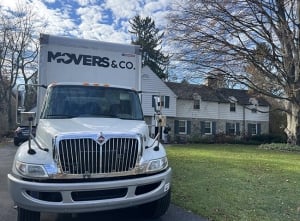
Movers & Co provides gun safe moving services in Lancaster, PA for gun safes, fireproof safes, and commercial safes in homes and businesses across Lancaster County. A safe is quoted as its own job with a crew and equipment matched to its weight, and it is surveyed before a date is confirmed.
A safe is the heaviest thing most people own and the hardest shape to move. Several hundred to a few thousand pounds concentrated on a footprint the size of a nightstand, with the weight sitting high and forward toward the door. That combination is why safes tip, why they go through floors, and why this is not a job to attempt with friends and an appliance dolly.
Why a Safe Is Not a Furniture Move
The weight is concentrated, not spread
A refrigerator spreads its weight over a wide base. A safe puts the same or more weight onto four small feet. That is a point load, and it is what damages hardwood, tile, and the floor structure underneath rather than just the finish.
It wants to fall forward
The door is the heaviest single component and it sits at the front. A safe tipped even slightly past balance cannot be recovered by hand, which is the moment people get seriously hurt.
Standard moving gear is not rated for it
An appliance dolly rated for a washing machine is nowhere near a 900 pound safe. The dollies, straps, and boards we bring are rated for the load, and the rating is checked against your safe before the day.
Insured people, not favors
Safes are the single most common source of serious injury in a DIY move, and a dropped safe damages the floor, the frame, and often the safe itself. Our movers are employees covered by workers compensation and the company is licensed and insured for the work.
Licensed, Insured, and Easy to Verify
Check anyone you let near a safe, and anyone who tells you their pickup truck is fine for it.
USDOT Number
3195256
MC Docket Number
1290652
Pennsylvania PUC License
8923115
Insurance
Liability and workers compensation carried on every job
Look up our federal record at FMCSA.gov using the USDOT number above, and ask for a current certificate of insurance whenever you want one. Every mover on the crew is an employee who has passed a background check.
Safe Types and Typical Weights
Weight varies enormously by wall thickness, fire rating, and door construction, so treat these as the planning ranges we work from rather than a spec for your safe. The plate on the back or the model number gives us the real figure.
| Safe | Typical weight | What it needs |
|---|---|---|
| Sheet steel gun cabinet | 100 to 250 lb | Two movers, standard equipment |
| Small fireproof or document safe | 100 to 400 lb | Two movers, rated dolly |
| 12 to 16 gun safe | 400 to 700 lb | Three movers, rated dolly, floor protection |
| 20 to 24 gun safe | 600 to 900 lb | Three to four movers, load spreading boards |
| 30 to 40 gun safe | 900 to 1,400 lb | Four movers, planned route, stair assessment |
| 48 gun and larger | 1,200 to 2,000 lb | Four or more movers, treated as a project |
| High security or TL rated safe | 2,000 lb and up | Surveyed individually before we quote |
| Commercial or floor safe | Varies widely | Weight and anchoring confirmed before scheduling |
Send us the make, the model, and a photo of the route it has to travel.
What You Need to Do Before We Arrive
Read this section before you book anyone. Two of these items are not optional and no legitimate mover will work around them.
Your responsibilities
- Empty the safe completely, including the shelves and anything loose in the base
- Remove all firearms and ammunition and transport them yourself, in line with Pennsylvania and federal requirements. If you are unsure what those are, confirm with a licensed dealer or your local law enforcement before moving day
- Remove cash, documents, jewelry, and anything else of value from the safe
- Tell us if the safe is bolted down, and arrange the unbolting if it is
- Have the combination or the key with you, not inside a locked safe, so the door can be secured for transport
- Clear the route at both properties and confirm where the truck can park
What we will not transport
- Firearms of any kind, loaded or unloaded
- Ammunition, primers, powder, or reloading supplies
- Cash, coins, bullion, or jewelry
- Documents you would not want out of your sight
- A safe that has not been emptied, because the weight is then unknown and unsafe to plan around
This is not a formality. A loaded safe can be hundreds of pounds heavier than its rated weight, which invalidates the equipment rating and the crew size the job was planned with. If the safe is still full when we arrive, the honest outcome is that we reschedule.
Equipment That Arrives With the Crew
Rated heavy dollies
Four wheel and stair capable equipment rated above the weight of your safe, not general purpose furniture gear.
Load spreading boards
Plywood or steel laid along the route so a point load is distributed across floor joists rather than pressed into one spot.
Ratchet straps
The safe is strapped to the equipment, and the equipment is strapped in the truck. Nothing relies on balance.
J bars and pry bars
For lifting a corner enough to get equipment underneath without gouging the floor or the safe.
Rollers and skates
For long flat runs across concrete, garages, and warehouse floors.
Blankets and edge padding
The finish and the door edge protected, since a scratched safe is the most common complaint after a badly run move.
Floor and jamb protection
Runners, hardboard, and door jamb padding along the whole route at both addresses.
A crew sized to the weight
The equipment does the lifting, but the control on a turn or a slope comes from having enough hands on it.
How the Move Runs
- Tell us the safe
Call (717) 690-1106 with the make, the model or the gun capacity, and both addresses. A photo of the safe and of the route helps more than a description.
- Survey and measurements
Doorway widths, the tightest turn, stair count and condition, and the floor type at both ends. We also want to know what is underneath the destination.
- Crew, equipment, and price
Confirmed in writing from the weight and the route, with anything we cannot do stated plainly rather than discovered later.
- You empty and unbolt
Contents out, firearms and ammunition removed and transported by you, and the anchoring dealt with before our arrival.
- Route protected
Runners, boards, and jamb padding down along the whole path before the safe is touched.
- Move and secure
Door locked or strapped shut, safe strapped to rated equipment, moved on the planned route, then strapped in the truck as its own load.
- Placement
Set down where you have chosen and where the floor will carry it, leveled if the floor demands it, and walked through with you before we leave.
Floors, Stairs, and Where a Safe Can Actually Go
Access and floor structure decide the price, and occasionally they decide whether the move is possible at all.
Concrete slab and basements
The easiest destination and the safest. No joists to worry about, and a basement corner on slab is where most large safes belong.
Wood framed ground floors
Usually fine, but the load is spread with boards during the move and the final position matters. Over a joist run is better than between.
Second floor placement
The question is not whether we can carry it up, it is whether the floor should hold it permanently. For heavier safes that is a question for a contractor or an engineer, not for a moving crew.
Descending a staircase
Harder and more dangerous than going up, because gravity is working with the load rather than against it. Stair count, turns, and tread condition all get assessed.
Turned and winder stairs
The limiting factor on most safe moves. A landing turn can rule out a heavy safe entirely, and you will hear that at the survey rather than on the day.
Doorways and thresholds
A safe plus the equipment under it needs more clearance than the safe alone. We measure both, and sometimes a door slab has to come off first.
We will tell you if we think a destination is a bad idea structurally, and we will not put a 1,400 pound safe on an upstairs floor on the strength of a customer saying it will be fine. That is not caution for its own sake, it is the difference between a move and a repair bill.
Where Safe Moves Go Wrong
The usual failures
- Walking a safe on its corners across a hardwood floor, which leaves marks that do not sand out
- Using equipment rated for appliances, which bends or fails under a real safe
- Letting the door swing during the move, which shifts the balance without warning
- Taking a staircase without enough hands, so the load controls the crew instead
- Setting it down over a single joist bay on an upper floor
- Loading it against other items in a truck, so a shift becomes a collision
What we do instead
- The safe travels on rated equipment from the moment it leaves its position
- The door is locked or strapped shut before anything moves
- Load is spread with boards over any floor we are crossing
- Stairs are assessed and crewed for the weight, or declined
- Final placement is chosen with the floor structure in mind
- It rides as its own strapped load with nothing stacked against it
Choosing Where the Safe Goes
Decide this before moving day. Repositioning a safe once it is down is a second booking.
On slab where possible
A basement or garage corner on concrete removes every structural question and makes anchoring straightforward.
Interior walls over exterior
Exterior walls are where condensation forms. An interior position keeps the safe and its contents drier over the years.
Off the damp
Away from a sump, a water heater, or anywhere that has flooded before, and off bare concrete if moisture is a known issue.
Corner placement
Two walls make it easier to secure and give the safe far less room to be worked at.
Door swing checked
A safe door needs its full arc. Measure it against the wall, the stair rail, and anything else in the room before we set it down.
Think about the next move
If it goes somewhere it can only be reached by dismantling a doorway, remember that getting it out again will cost more than getting it in.
Anchoring and Unbolting
Most safes worth owning are bolted to the floor, and that has to be dealt with at both ends of the move.
How to handle it
- Tell us at the survey whether the safe is currently anchored, and into what: slab, subfloor, or a wall
- Arrange the unbolting before our arrival, or tell us so it can be quoted rather than discovered
- Have the fixings and any anchor kit available if the safe is being re-secured at the new address
- Decide the final position in advance, because anchoring commits it
- If the safe is being anchored into a finished floor, agree who is drilling and accept that the hole stays
Worth knowing
- Some manufacturers allow the door to be removed to reduce weight for a difficult route, but that is a locksmith’s job and not something a moving crew should attempt
- An unanchored safe is far easier to defeat, so re-securing it matters more than most owners expect
- Drilling into a post-tension slab is a job for a specialist, not for anyone working from a hardware store kit
- We do not open, service, or work on locks, dials, or electronic keypads under any circumstances
Safes for Businesses and Dealers
Commercial and office safes
Relocated during an office move or a fit-out, scheduled outside trading hours where the building requires it.
Retail and hospitality
Drop safes and cash safes moved between locations or repositioned within a store.
Floor and in-ground safes
Weight, anchoring, and removal method confirmed before a date is set. Some are not removable without a specialist.
Dealers and gun shops
Display and storage safes moved for shops, ranges, and clubs.
Clubs and ranges
Storage cabinets and safes relocated within a facility or between two of yours.
Deliveries from a retailer
A safe delivered to your curb or garage and taken to where it is actually going, including up or down a level.
A full site relocation with several safes, offices, and building paperwork runs through commercial moving so the scope and the scheduling are handled together.
Where We Move Safes
- Address
- 1698 Temple Ave, Unit 1
Lancaster, PA 17603 - Phone
- (717) 690-1106
- contact@moversandcompany.com
- Hours
- Mon to Fri: 8:00 AM to 12:00 AM
Sat: 9:00 AM to 6:00 PM
Sun: 9:00 AM to 3:00 PM
Moving the whole house and the safe together? It is quoted inside your residential move but crewed and equipped as its own job, which is usually cheaper than booking the two separately.
Gun Safe Moving FAQ
Do I have to empty the safe before you arrive?
Yes, completely. All firearms and ammunition have to be removed and transported by you in line with Pennsylvania and federal requirements, and we recommend confirming those with a licensed dealer or your local law enforcement if you are unsure. Cash, jewelry, and documents should come out too. A full safe can be hundreds of pounds over its rated weight, which invalidates the crew size and equipment the job was planned around.
Can you get a safe up or down stairs?
Often, and it depends on the weight, the stair count, the turns, and the condition of the treads. Descending is the harder direction because gravity works with the load. A turned or winder staircase is the most common reason a heavy safe cannot go where someone wants it, and we will say so at the survey rather than on the day.
Can a safe go on a second floor?
Getting it up there is usually the easy part. Whether the floor should carry it permanently is a structural question, and for heavier safes that is a question for a contractor or an engineer rather than for a moving crew. We will move it once you have an answer, and we will tell you honestly if we think the destination is a bad idea.
Do you unbolt the safe and re-anchor it at the new place?
Tell us at the survey whether it is currently anchored and into what, and we will tell you exactly what we can do and what needs arranging separately. Decide the final position before moving day, because anchoring commits it and repositioning afterwards is a second booking.
What does it cost to move a gun safe in Lancaster?
It depends on the weight, the crew and equipment it needs, and the access at both ends. A 500 pound safe rolling across a garage slab and a 1,400 pound safe coming down a turned staircase are not remotely the same job. The survey is free and the price is in writing before you commit.
What if the safe will not fit through a doorway?
We measure the safe, and the safe on the equipment, against every opening on the route before the day. If the clearance is not there, options include removing a door slab, choosing a different route or destination, or on some models having a locksmith remove the door to reduce the width and weight. That last one is a locksmith’s job, not ours.
Can you move a safe within the same house?
Yes, and it is a common booking. Repositioning within a room, moving it to a basement, or getting it out of a closet a previous owner installed it in. The same protection and equipment apply because the distance is not what causes the damage.
Do you move commercial safes and floor safes?
Commercial and drop safes, yes. In-ground and floor safes are assessed individually, because some cannot be removed without a specialist and we would rather tell you that before you have paid anyone. We do not open, service, or work on locks, dials, or keypads at any point.
More questions? See our full FAQ or contact us directly.